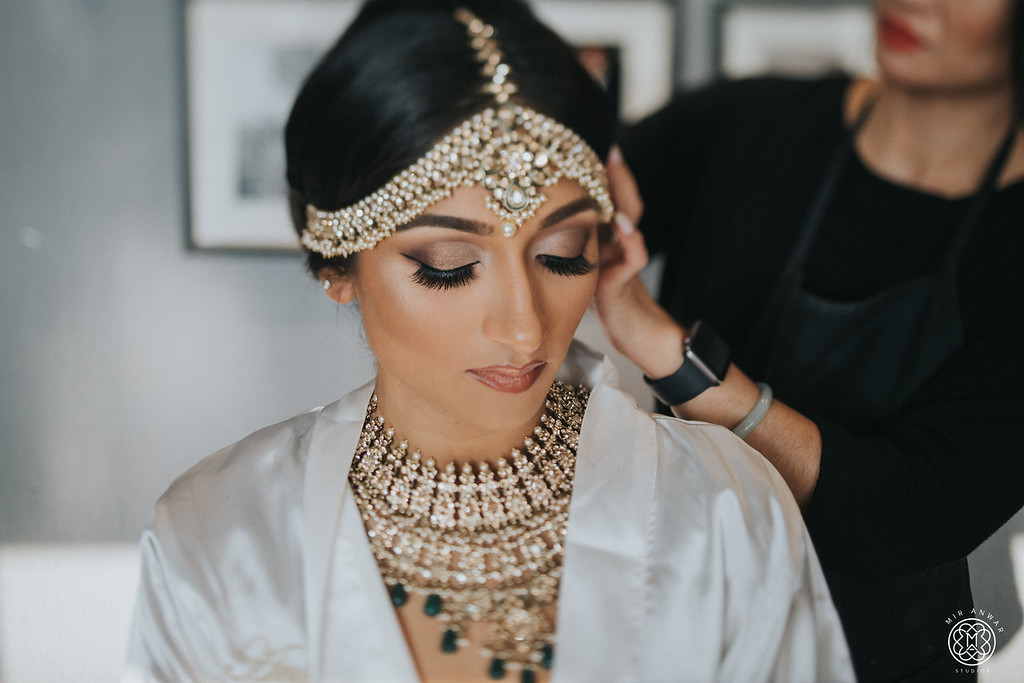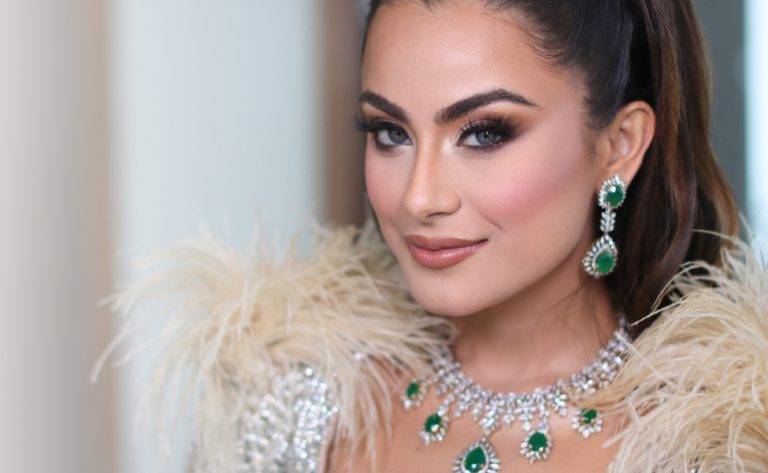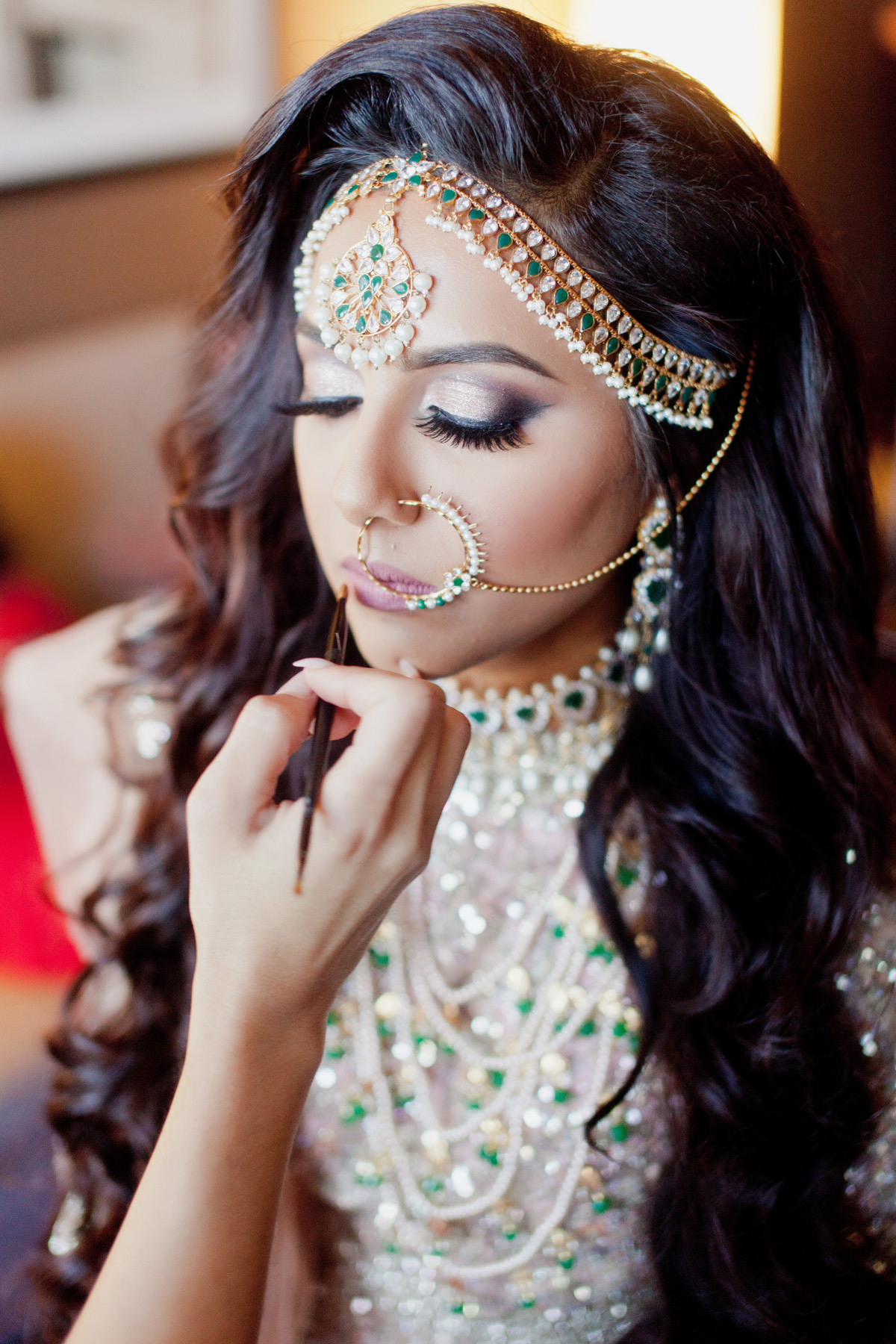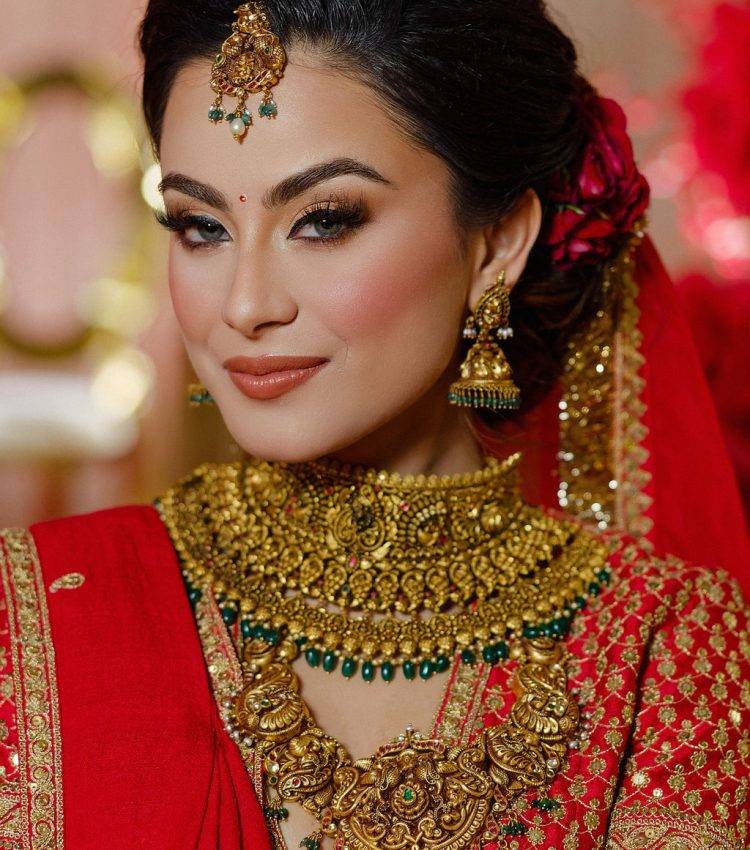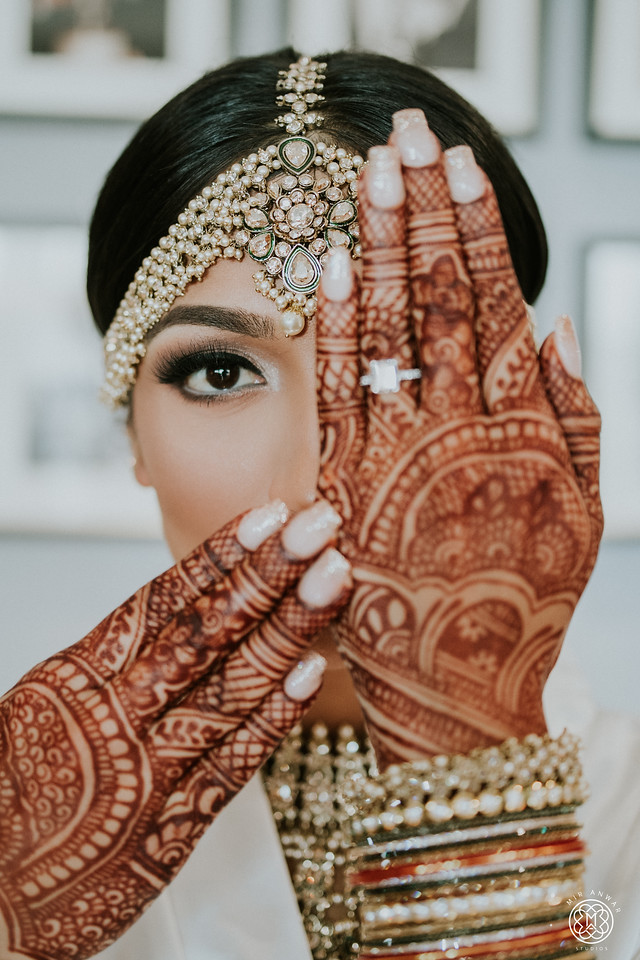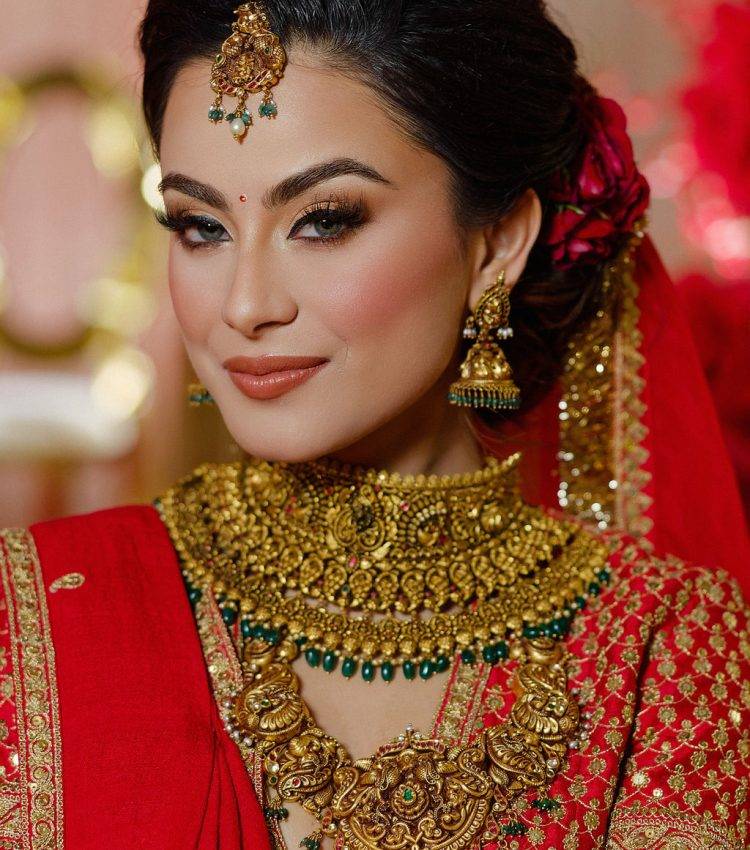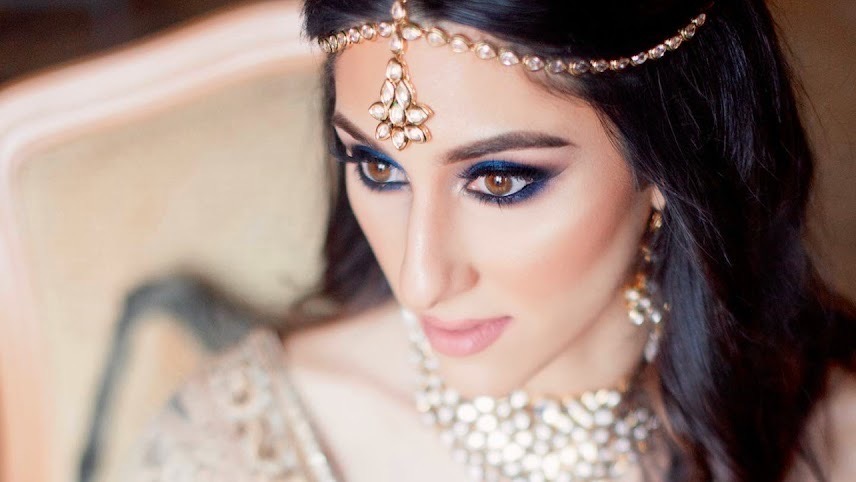
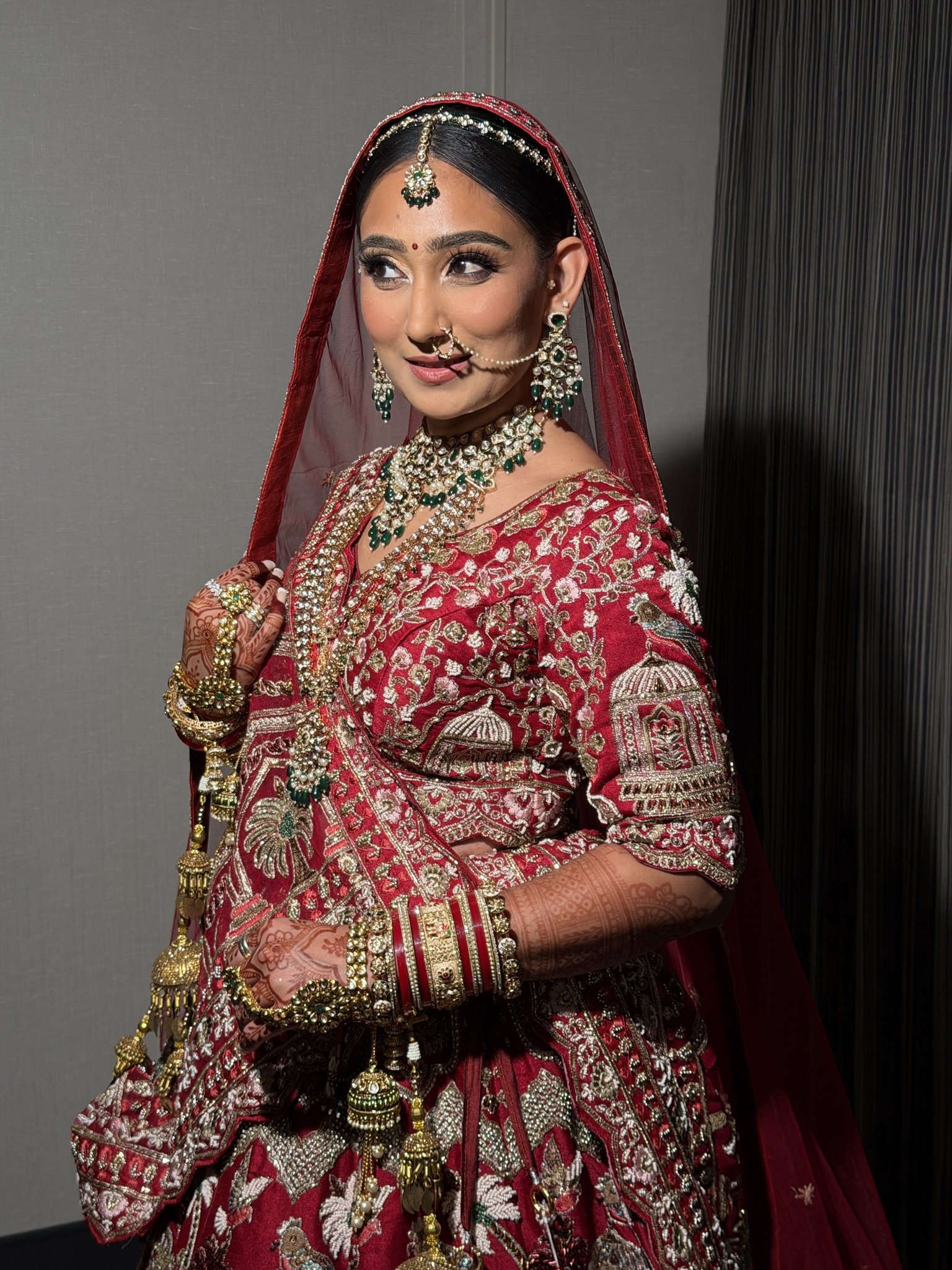
“When you look at a bride, you should see her first, not her makeup.”
After 18 years as a professional bridal hair and makeup artist, this remains one of the most important principles behind my work.
I’ve worked with Indian, Pakistani, South Asian, and multicultural brides who want to look beautiful on their wedding day without losing the very features that make them who they are.
And one question I believe more brides should ask before booking is:
What’s the difference between hiring a general bridal hair and makeup artist and an Indian bridal makeup artist who specializes in South Asian weddings?
The difference isn’t simply about creating dramatic eyes, elaborate hairstyles, or traditional makeup.
It’s about understanding different skin tones, facial proportions, hair textures, cultural dressing, jewelry placement, family traditions, and the coordination of multiple wedding events.
Most importantly, it’s about understanding the bride herself.
Through my work specializing in South Asian bridal hair and makeup, I’ve learned that what brides truly value is having an expert who can thoughtfully bring every detail together.
Because your wedding day shouldn’t be the day you’re teaching your makeup artist what to do.
What Is the Difference Between a General Bridal Makeup Artist and an Indian Bridal Makeup Specialist?
A general bridal makeup artist may be highly skilled at creating beautiful wedding makeup and hairstyles.
But an Indian or South Asian bridal specialist should bring additional experience in planning and executing the complete beauty needs of a culturally specific, often multi-event wedding.
That may include:
- Understanding the range of South Asian skin tones and undertones.
- Creating hairstyles that accommodate traditional jewelry, dupattas, and veils.
- Understanding cultural dressing requirements for different ceremonies.
- Designing distinct yet cohesive looks across multiple wedding events.
- Working within demanding bridal preparation timelines.
- Guiding brides through outfit, accessory, and beauty decisions.
- Navigating family involvement while respecting the bride’s personal preferences.
Of course, not every artist who advertises themselves as a specialist has the same level of expertise.
And being Indian or South Asian doesn’t automatically make someone better qualified to work with South Asian brides.
Specialization should be demonstrated through consistent artistry, practical experience, cultural understanding, and the ability to deliver a complete bridal experience.
Understanding Indian and South Asian Skin Tones Requires Technical Expertise
One of the biggest misconceptions about Indian bridal makeup is that every bride wants heavy foundation, dramatic eyes, and bold red lipstick.
That’s simply not true.
Just because a bride is wearing a colorful lehenga, intricate embroidery, and traditional jewelry doesn’t mean her makeup needs to be equally dramatic.
Some brides want soft, natural-looking makeup. Others prefer something more defined and glamorous.
There is no single Indian bridal makeup look.
And there is certainly no single South Asian skin tone.
Why Foundation Matching Matters
South Asian complexions range from fair to medium, olive, rich brown, and deep skin tones.
Undertones vary just as much.
An experienced artist needs to understand how different colors interact with the skin and how to create an even complexion without making it look gray, muddy, orange, or excessively light.
I remember one bride telling me about her engagement photo shoot.
She noticed a gray cast developing around her face after the makeup artist had already applied her foundation.
She actually had to tell the artist that she needed color correction.
Unfortunately, by that point, the foundation was already on.
This is why the order of application and understanding color theory are so important.
You can’t always fix incorrect color matching by adding more foundation.
Sometimes that simply creates a heavier result.
My Approach to Natural, Flawless Bridal Makeup
When I work with my brides, I pay attention to discoloration, undertones, the relationship between the face and neck, and how the finished complexion will look in different lighting.
I use color correction where needed before creating the final complexion.
But my philosophy has never been about covering every feature with makeup.
I want the skin to look like skin.
Smooth, polished, and naturally elevated.
Even the techniques and tools used to blend complexion products play a role in that finish. It’s part of why I developed the JTorry Beauty Belly Button Blender, a tool designed to help blend foundation, concealer, and other complexion products smoothly.
The ultimate goal is not to make everyone look the same.
It’s to enhance the individual.
When reviewing an artist’s work, I encourage brides to look at real skin texture, color consistency, and whether the makeup looks beautiful without excessive photo editing.
South Asian Bridal Hairstyling Requires More Than Creating a Beautiful Updo
Hair is another major difference between a general bridal booking and a specialized South Asian bridal experience.
An artist might know how to create a beautiful updo or glamorous waves.
But can they create a hairstyle that supports a dupatta, traditional jewelry, and several hours of wedding activities?
That’s an entirely different consideration.
Understanding Different Hair Types and Textures
South Asian brides have different hair textures, densities, and styling needs.
Some have thick, heavy hair that needs proper preparation and support.
Others have finer hair and need carefully created volume.
Some struggle with frizz, while others have difficulty getting curls or volume to last.
A professional bridal hairstylist should understand how to prepare the hair, control texture, build volume, and create lasting structure.
Knowing how to tease hair properly matters.
Knowing how to secure an updo matters.
And knowing how to build a hairstyle around traditional accessories matters.
A Bride Who Thought She Could Never Wear Her Hair Up
I remember working with a bride who was convinced updos didn’t look good on her.
She had tried wearing her hair up before and never liked the result.
But when I looked at her features, I could see that the problem wasn’t necessarily the updo.
It was how the hairstyle framed her face.
I adjusted the face-framing pieces and created a shape that complemented her proportions.
She ended up loving her updo.
That’s why understanding the artistry behind hairstyling is so important.
Sometimes brides eliminate styles because they haven’t experienced a version that was designed specifically for them.
Your inspiration should be adapted to your features, not simply copied.
Cultural Dressing, Dupatta Draping, and Jewelry Placement Are Essential Skills
One of the most important differences in a South Asian bridal beauty experience is cultural dressing.
For many brides, the transformation isn’t complete when the makeup and hairstyle are finished.
There may still be a dupatta to drape, a tikka to center, a jhumar to secure, jewelry to position, and other accessories to incorporate.
These details require planning and experience.
Not Every South Asian Bride Follows the Same Traditions
Here’s something I want every bride to understand.
South Asian weddings are not all the same.
A Gujarati bride may have different dupatta-draping traditions from a Punjabi bride.
A Pakistani bride may have different styling expectations from an Indian bride.
A Nepali bride may incorporate accessories and traditions that reflect her family’s cultural background.
Religious ceremonies also carry their own requirements.
And even within the same community, families may have different customs depending on their traditions and personal preferences.
That’s why I never assume that I know exactly how a bride wants her accessories or dupatta styled just because I’ve worked with other brides from her community.
I always ask.
Why the Bride’s Input Matters
Some brides give me complete creative freedom.
Others have a specific vision but need help understanding how to achieve it.
My job is to understand those priorities and then use my expertise to guide the execution.
For example, when planning dupatta draping, I consider the hairstyle, fabric, desired shape, ceremony requirements, and how the bride will move throughout the event.
The same applies to the tikka and other jewelry.
They need to be positioned intentionally and secured appropriately without compromising the hairstyle or the bride’s comfort.
I’ve seen bridal looks where the tikka hangs too low, the dupatta looks flat, or the hairstyle doesn’t provide adequate support.
These details may seem small individually, but they affect the overall bridal presentation.
A bride shouldn’t have to spend her wedding morning telling the artist how to secure every accessory.
The professional should have the experience to guide that process.
Multi-Event Indian Weddings Require a Complete Bridal Beauty Plan
One of the biggest differences between a single-event bridal service and South Asian bridal beauty is the number of events involved.
Many of my brides have multiple celebrations across two or three days.
Some have five events, each requiring its own makeup, hairstyle, outfit, and jewelry.
This isn’t simply about applying makeup five times.
It’s about creating five distinct looks that still feel cohesive.
Every Event Should Have Its Own Beauty Direction
When I begin working with a bride, I start by identifying her non-negotiables.
What does she love?
What doesn’t she like?
How does she want to feel?
What is the overall vision for her wedding?
From there, I begin developing the beauty direction for each event.
For example, a bride might want:
- A soft, expressive look for her Mehndi.
- A glamorous hairstyle and defined makeup for her Sangeet.
- A traditional yet timeless bridal look for her wedding ceremony.
- A polished, sophisticated transformation for her reception.
These are examples, not rules.
The goal is to create a visual story that complements each event while still reflecting the same woman.
I don’t want my brides looking like five completely different people.
I want them to recognize themselves in every look.
A Beautiful Look Also Needs to Be Finished on Time
The wedding timeline is another important consideration.
Indian and South Asian weddings often involve tightly scheduled events, early preparations, and limited time between ceremonies.
A bridal specialist should know how to plan the necessary time for makeup, hairstyling, jewelry placement, and dressing.
And when several services need to happen within a short period, the artist should understand when additional assistance may be necessary.
This is particularly important for destination weddings, where travel, venue logistics, and environmental conditions can affect the bridal preparation process.
I’ve written more about these considerations in my guide to multicultural destination wedding bridal makeup.
A beautiful bridal look shouldn’t come at the expense of the bride’s schedule.
You should be able to enjoy the experience without wondering whether you’ll be ready on time.
Why a Bridal Trial Is an Important Part of the Experience
One of my strongest recommendations is to work with an artist who offers a thoughtful bridal trial or a clearly structured planning process.
Your wedding day shouldn’t be the first time you discover whether your desired makeup or hairstyle works for you.
A bridal trial allows you to explore the look, understand your preferences, and refine the details before the wedding.
But I believe a trial should go beyond simply testing a lipstick shade or eyeshadow color.
I Guide My Brides Instead of Making Decisions for Them
One thing many of my brides appreciate is that I don’t push my ideas onto them.
Instead, I guide them.
When a bride asks for my opinion, I first want to understand what matters to her.
Then I may present two different options and explain why each creates a different result.
We look at how the choices relate to her features, her outfit, her jewelry, and the overall wedding vision.
And then I ask her how she feels.
She makes the decision.
Because my job isn’t to replace her judgment with mine.
It’s to give her the understanding and confidence to make an informed decision.
That’s why I believe bridal consultations should be educational and collaborative.
You should leave understanding why your look works for you.
If you’re preparing for your first appointment, you can find more information about the planning process in my bridal hair and makeup FAQs.
What If You Cannot Attend Your Bridal Trial?
Not every bride lives near her chosen artist.
This is especially common with destination weddings and brides planning celebrations from another city.
An in-person trial is valuable, but when it’s not possible, a thoughtful virtual consultation can still help establish the beauty direction.
I explain how I approach this in my article on what happens if you cannot attend your bridal trial.
The important thing is having a clear plan and shared expectations before the wedding day.
The Complete Bridal Look Should Be Beautiful From Every Angle
Something I pay close attention to is how the complete bridal look works together.
Not just the makeup.
Not just the hair.
Everything.
The outfit, jewelry, dupatta, hairstyle, complexion, and finishing details should create one cohesive presentation.
And it needs to look beautiful from every angle.
Your wedding photographer isn’t only capturing the front of your face.
You’ll be photographed turning, walking, sitting, looking down, embracing your family, and standing beside your partner.
Your bridal look should feel balanced throughout those moments.
The Details That Can Make a Bridal Look Feel Unfinished
A tikka that’s slightly off-center.
A dupatta that isn’t supported properly.
An updo without the correct shape.
Foundation that looks disconnected from the neck.
Jewelry that competes with the hairstyle.
These are the details I pay attention to as an artist.
I’ve learned to evaluate the finished bridal look as a complete composition.
My background as a fine-art painter also influences how I see facial proportions, color, and balance.
You can learn more about that perspective and my professional journey on my About Jenny Torry page.
And while personal preferences are always important, I believe a professional should also understand the principles that make a look feel harmonious.
Because beautiful artistry doesn’t happen by accident.
What Are You Really Investing in When Hiring an Indian Bridal Makeup Specialist?
Let’s talk about the investment.
Wedding budgets matter, and I understand why brides compare different hair and makeup packages.
But I encourage brides to look beyond the price and consider what the artist is actually providing.
When you hire an experienced specialist, you may be investing in much more than the time spent applying makeup or styling hair.
You’re investing in technical knowledge, professional judgment, cultural styling experience, preparation, communication, and the ability to execute a complete bridal vision.
And just as importantly, you’re investing in peace of mind.
Your Bridal Artist Should Help You Feel Like a Bride
One of the things I’ve witnessed is how stressful it can become when a bride has to micromanage her artist.
She may find herself explaining how the tikka should sit, pointing out problems with the dupatta, or worrying that the makeup doesn’t look the way she imagined.
And the difficult part is that she may not even know how to fix those things herself.
That’s why she hired a professional.
You should be able to sit in the chair and receive the experience rather than manage every detail of it.
For me, that’s a major part of luxury bridal beauty.
It’s not just the finished look.
It’s the experience of getting there.
When comparing packages, look at the complete service, the artist’s responsibilities, and the level of preparation included.
You can explore JTorry’s bridal hair and makeup investment to understand how I structure personalized bridal services for different wedding needs.
Five Questions Every Indian Bride Should Ask Before Hiring a Makeup Artist
If you’re currently searching for an Indian bridal makeup artist in Dallas or planning a destination wedding, here are five questions I recommend asking before booking.
1. Can I See Examples of Your Work on Brides With Similar Features and Skin Tones?
Look for consistency.
Pay attention to foundation matching, makeup texture, hairstyle proportions, and overall balance.
Don’t evaluate an artist solely by one heavily edited photograph.
Ask to see real bridal work across different complexions, hairstyles, and wedding events.
You can begin by reviewing my JTorry bridal portfolio and beauty experience to see how different looks are customized for individual brides.
2. Do You Offer a Bridal Trial and Personalized Consultation?
Ask what the trial includes and when it takes place.
Will you be able to discuss your outfits, jewelry, and different wedding events?
Does the artist guide you through your choices?
Is the trial included in the package or offered separately?
A good consultation should help you feel more confident about the decisions being made.
3. Are You Experienced With My Cultural Dressing Requirements?
If you’re wearing a dupatta, tikka, jhumar, veil, or additional traditional accessories, confirm that the artist has experience with those specific elements.
Ask whether draping and jewelry placement are included.
Also explain any ceremony-specific traditions or family expectations.
Don’t assume every bridal artist provides cultural dressing services.
4. Can You Complete Everything Within My Wedding Timeline?
This is especially important for brides with multiple events.
Share your preparation schedule and ready-by times.
Ask how much time the artist needs for makeup, hair, and dressing.
Find out how they coordinate transitions between different looks and whether additional artists may be required.
An experienced professional should be able to identify potential scheduling concerns before the wedding.
5. Does This Artist Align With My Values and Expectations?
This may be the most overlooked consideration.
How does the artist communicate?
Do they answer questions professionally and within a reasonable timeframe?
Do they use clean brushes and maintain appropriate hygiene standards?
Do they listen carefully to what matters to you?
And does their portfolio consistently reflect the style of beauty you value?
An artist might be very talented and still not be the right fit for your personal preferences.
You deserve someone whose work and professional approach give you confidence.
Should You Hire the Same Bridal Makeup Artist Your Family Used?
Not necessarily.
One of the biggest pieces of advice I give brides is to avoid choosing an artist solely because a family member or friend hired them.
A personal recommendation is a wonderful starting point.
But just because an artist was perfect for your sister, cousin, or friend doesn’t automatically mean they’re the right choice for you.
You have different features.
Different preferences.
Different expectations.
And possibly a completely different wedding vision.
I believe every bride deserves to make this decision based on what she genuinely values.
If you want natural-looking, elevated makeup, your artist’s work should demonstrate that style.
If cultural dressing matters to your ceremony, your artist should understand those responsibilities.
And if you want a calm, thoughtful experience, pay attention to how the artist treats you throughout the booking and planning process.
Because the right artist does more than make you look beautiful.
They help you feel confident about who you are.
Final Thoughts: Choose an Artist Who Understands You
After 18 years in bridal beauty, there’s one thing I’ve never changed about my approach.
I want my brides to feel like themselves.
Beautifully elevated.
Not transformed into someone they don’t recognize.
Not pressured into a makeup style because it’s trending.
And not left managing their beauty experience when they should be enjoying one of the most meaningful celebrations of their lives.
Whether you hire a general bridal artist or a specialist, the most important thing is choosing someone whose expertise, work, and values align with what you need.
Someone who understands your features.
Someone who respects your traditions.
Someone who knows how to guide you.
And someone who genuinely cares about the woman behind the makeup.
Because when people look at you, they should see you first.
The makeup is simply there to enhance what already makes you beautiful.
Experience Luxury Indian and South Asian Bridal Beauty With JTorry
At JTorry, I specialize in luxury Indian, South Asian, multicultural, and destination bridal hair and makeup, with a personalized approach centered on artistic precision, cultural understanding, and thoughtful beauty planning.
From your first consultation to your final bridal look, my goal is to create an experience that feels intentional, authentic, and beautifully aligned with you.
Based in Dallas–Fort Worth, I work with brides locally and travel for destination weddings.
If you’re beginning to explore your options, learn more about my Dallas luxury bridal hair and makeup services and how we can bring your wedding beauty vision together.
Feel like yourself. Beautifully elevated.